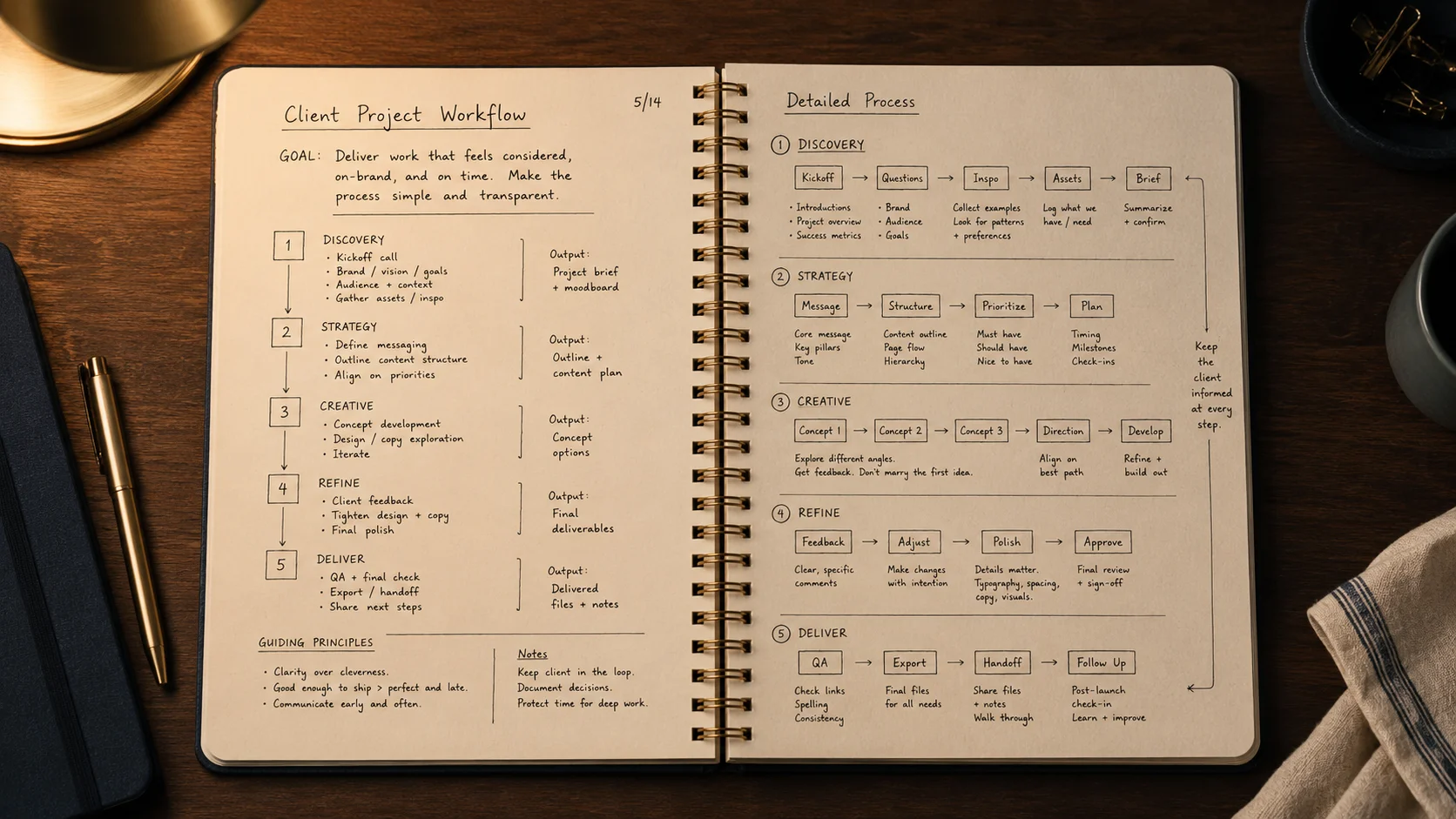
A client asked me to open my process completely. Every step of how I design a page, write a headline, plan a posting calendar, and decide what a brand should say and when.
Not the finished work. They already own that, and they should. That was always the deal.
What they wanted was the thinking behind it. Twenty years of trial and error, condensed into a file an AI could reference so the work could keep happening without me in the room.
In the same conversation, replacing me came up as an option worth exploring.
I said no. Not the file, and not the option.
I want to walk through why, and I want to show you the research behind it, because I do not think this is a strange or isolated request. I think it is becoming a normal one, and most people still assume it only happens at companies like Meta or Google. It does not.
A note before we start: I build AI systems for a living. I run an AI education company, I use Claude and ChatGPT every working day, and I think this technology is genuinely useful for the kind of marketing and design work I do. This is not an anti-AI article.
It is an article about ownership. About the difference between the work a client pays for and the twenty years of judgment that produced it. And about a request that is landing on more desks than the headlines suggest, mine included.
Part 1: This Is Not a Big Tech Story
The stories that make the news are the big, dramatic ones. A large company cutting a tenth of its workforce. A household name restructuring an entire division. It is easy to read those headlines and assume this only happens to software engineers and product managers at companies most of us will never work for, far away from a marketing agency in Michigan.
The data says otherwise.
A 2026 Gartner survey found that 64% of organizations already implementing AI had used their own employees to generate the training data for it. Only 22% of those organizations told employees how that data would affect future staffing decisions.
Harvard economist David Deming has pointed out that AI adoption is actually moving faster inside small companies than large ones, because a small team can reorganize around a new tool with far less internal friction than an enterprise can. TIME profiled a small business owner who used Claude Opus 4.5 to rebuild the internal software his company depended on, then reduced his team from 48 employees to 30 without a drop in revenue. With roughly 46% of Americans working for small companies, the real scope of this shift may never produce the kind of mass layoff headline that a large tech company generates. It is happening one small business at a time, one job description at a time.
Even the owners doing the automating are not exempt from the logic. Scott Bell, a bankruptcy lawyer who built AI agents to handle his own client intake, told the New York Times plainly that he expects the same technology will eventually be able to do his job too, for less money and faster than he can.
And in my own field, it has already happened at scale. The Chinese marketing agency BlueFocus ended its human copywriters' and designers' contracts entirely in 2023, just weeks after the company secured an Azure OpenAI license and partnered with Baidu to build its own AI marketing system. That is not a hypothetical. That is a full-service marketing agency deciding it no longer needed the people who used to do the writing and the design.
Three numbers worth sitting with from this section.
- 46 percent of Americans work for a small company, per TIME's reporting.
- One small business went from 48 employees to 30 after an internal AI rebuild, with no drop in revenue.
- And 2023 is the year a marketing agency ended all of its human writer and designer contracts.
Part 2: The Law Has Not Caught Up
Here is the uncomfortable part. In the United States, employment-at-will means an employer can generally require a worker to complete any lawful task as a condition of keeping their job, and documenting your own workflow for an AI system is a lawful task.
A few real guardrails are starting to form. The National Labor Relations Board issued guidance in 2025 stating that employers cannot retaliate against workers for raising concerns about AI replacing their jobs, because that conversation counts as protected concerted activity. The Writers Guild of America and SAG-AFTRA both negotiated contract language addressing AI replicas and credit, and unions in other industries are already using that language as a template. Employment attorney Sarah Chen of Littler Mendelson has pointed out that if an employer tells a worker that AI training will not affect their position, and then eliminates that position a few months later, the worker's documentation of that promise can support a fraud or promissory estoppel claim.
But most workers asked to do this kind of work are not unionized, and most were never given a promise in writing to point back to. That is the gap.
Valerio De Stefano, a law professor at Osgoode Hall Law School, wrote about this plainly for the labor law publication OnLabor. Being required to train the person, or the system, that may replace you is one of the more degrading experiences a workplace can produce, and current employment law in the United States and Canada gives a worker only limited ways to resist it, because the work product itself, and the tacit knowledge behind it, sit in a legal gray area that predates AI and was never fully settled.
More than a third of surveyed AI data workers already know they are training a system to replace their own job.
Communications Workers of America survey, cited by Prof. Valerio De Stefano, OnLabor
The Communications Workers of America surveyed workers already doing this kind of labor and found that 52% said they were training AI to replace someone else's job, and 36% said they were training AI to replace their own. That second number is the one worth sitting with. More than a third of the people building these systems already know exactly what they are building.
Part 3: The Clearest Example Is Already Viral, and It Started as a Joke
If you want to see where this goes once nobody sets any limits on it, look at what happened in China in April 2026.
A developer named Tianyi Zhou built a GitHub tool called Colleague Skill as a joke. Feed it a coworker's chat history and a few profile details, and it produces a detailed manual describing exactly how that person does their job. It went viral, pulling more than 5 million likes across Chinese social platforms.
A tech worker in Shanghai named Amber Li tried it on a former colleague as an experiment. She told MIT Technology Review the result was unnervingly accurate, down to the person's small verbal habits and even their punctuation.
Not everyone found it funny. Koki Xu, an AI product manager in Beijing with a background in law, built and published an opposing tool that rewrites workplace manuals into language too vague for an AI to act on, specifically meant to slow the trend down. She told MIT Technology Review she wanted workers to have a voice in how a technology like this gets used against them. Xu also named the exact tension at the center of this whole article: a company can reasonably argue that files created on a company laptop belong to the company, but a tool like Colleague Skill captures personality, tone, and judgment, and that makes any clean ownership claim much harder to defend.
The named examples keep stacking up once you start looking. Reuters reported that Meta began installing software to track employee keystrokes and mouse movement for AI training, at the same time the company was preparing workforce cuts. A major search company restructured its ad sales division in early 2026, after employees had spent months training an internal tool on their own client workflows. Klarna's CEO has said publicly that the company's AI assistant now handles the workload of roughly 700 customer service employees, and the company's headcount has fallen from a much larger peak to around 4,000.
None of this is science fiction. None of it is limited to one country, one industry, or one company size. It is a pattern, and it was already running in my own industry before my client ever asked me to sit down and document my process.
If you are a business owner reading this and recognizing your own AI rollout in it, there is a way to capture institutional knowledge without deceiving or dispossessing the people who built it. That is the AI governance work I do for teams across the Great Lakes Bay Region, and it starts with a plan, not a surveillance program. Book a 20 minute call. Contact
Part 4: What I Told My Client
I did not refuse everything. The designs, the campaigns, the copy, the strategy documents, all of it belongs to the client. That was always the deal, and I would tell any worker in a similar spot to be equally clear about that line. Finished work product made on the clock is not the argument worth having.
What I would not hand over was the twenty years behind it. The reason I choose one headline over another. The judgment that took two decades of client work, failed campaigns, and long nights to build. That was never part of the invoice, and I am not willing to package it into a file whose stated purpose was to make me optional.
If you are ever handed a version of this request, a few questions are worth asking before you agree to anything.
- Ask what happens to your role if the documentation works exactly as intended. A straight answer tells you a lot. A vague one tells you more.
- Ask whether the request is in writing. If it is not, put your own understanding of the conversation in writing yourself, even if it is only an email to your own inbox, timestamped the same day. Sarah Chen's point about promissory estoppel only works if there is something to point back to later.
- Ask what the company means by process or workflow. There is a real difference between documenting a checklist and documenting the reasoning a checklist can never fully capture. The first is a reasonable ask. The second is your career, condensed.
- Ask yourself, honestly, whether you are being asked to become more replaceable or more valuable. Those are not always opposite outcomes. Documenting your process well is often genuinely good practice, and it can protect everyone, including you. But if the stated goal, or the goal you can plainly infer, is your own removal, you are allowed to say no. I did.
The Bottom Line
Twenty years of craft is not a training file. It is not a line item a client can requisition the way they requisition a logo or a landing page.
The work you finish for someone belongs to them. The judgment that produced it belongs to you, and no one is entitled to a copy of it just because they are worried about what happens if you are not in the room.
I turned the request down. If a version of it ever lands on your desk, you are allowed to turn it down too.
Sources and Data References
The Scale of the Problem
Gartner, 2026. Survey on AI training data sourced from existing employees. 64 percent of organizations had used employees to generate AI training data, only 22 percent disclosed the staffing impact.
TIME, May 2026. The Small Businesses Already Replacing Workers With AI. Harvard economist David Deming on faster small firm AI adoption, plus case studies of small businesses reducing headcount after internal AI builds.
The New York Times, via Black Enterprise, 2026. Scott Bell, bankruptcy lawyer, on AI agents handling client intake and his own expectation of eventual replacement.
Tech.co, 2026. Company by company tracker of AI related workforce changes, including BlueFocus ending its human copywriter and designer contracts in 2023.
Legal and Ethical Ground
National Labor Relations Board guidance, 2025. Protected concerted activity for workers raising AI job security concerns.
Employment attorney Sarah Chen, Littler Mendelson. On promissory estoppel and the value of documentation when employers make staffing promises tied to AI training.
Valerio De Stefano, Osgoode Hall Law School, writing for OnLabor, May 2026. Training Your Replacement, One Keystroke at a Time.
Communications Workers of America survey, cited via OnLabor. 52 percent of surveyed AI data workers training AI to replace someone else's job, 36 percent training AI to replace their own.
Reuters, via OnLabor and Gizmodo, April 2026. Reporting on Meta's employee keystroke and mouse tracking software for AI training.
The Colleague Skill Story
MIT Technology Review, April 2026. Chinese tech workers are starting to train their AI doubles, and pushing back. Reporting on Colleague Skill, Tianyi Zhou, Amber Li, and Koki Xu.
Named Companies
Tech.co, 2026. Workforce reduction figures for major AI adopting companies, including Klarna's shift toward AI handled customer service.
Industry reporting, 2026. On internal AI tool rollouts preceding division level restructuring at large technology companies.