Someone in your marketing team is using ChatGPT to draft social posts.
Someone in sales is writing follow-up emails with it. Someone in operations is testing it on meeting notes. A manager tried Copilot. An owner watched a few AI videos. A team member just discovered a tool that promises to automate half their job.
That is where most businesses are. Not behind. Just unstructured.
The problem in most companies is not unwillingness to use AI. It is using AI without a shared strategy, without clear guardrails, without role-based training, and without a repeatable system for turning useful experiments into actual operational improvement.
That is the gap we close at Understanding Your AI.
A note before we start
I am not an AI skeptic. I run an AI education and strategy company. I build production AI systems, ship real applications, and lead AI strategy for businesses across Michigan's Great Lakes Bay Region every week.
This article walks through the framework we run every client engagement through. It is enough to give you a real mental model of how good AI adoption actually works. It is not enough to replace the work. That is on purpose. Real adoption happens in your boardroom and on your shop floor, not in a blog post.
If you finish this and want help running the playbook for your team, the contact links throughout will take you to the right place.
Those numbers tell one story. AI adoption is everywhere. AI strategy is rare. The reason most pilots fail is not that the tools do not work. It is that the rollout is unstructured. Tools get adopted without a strategy. Prompts get written without context. Outputs get used without review. Data ends up in the wrong systems. Leadership knows AI matters, but nobody is connecting the dots.
Let's get into the framework that fixes that.
Part 1: Know Where AI Actually Fits
One of the first things we teach is that AI is not one single thing.
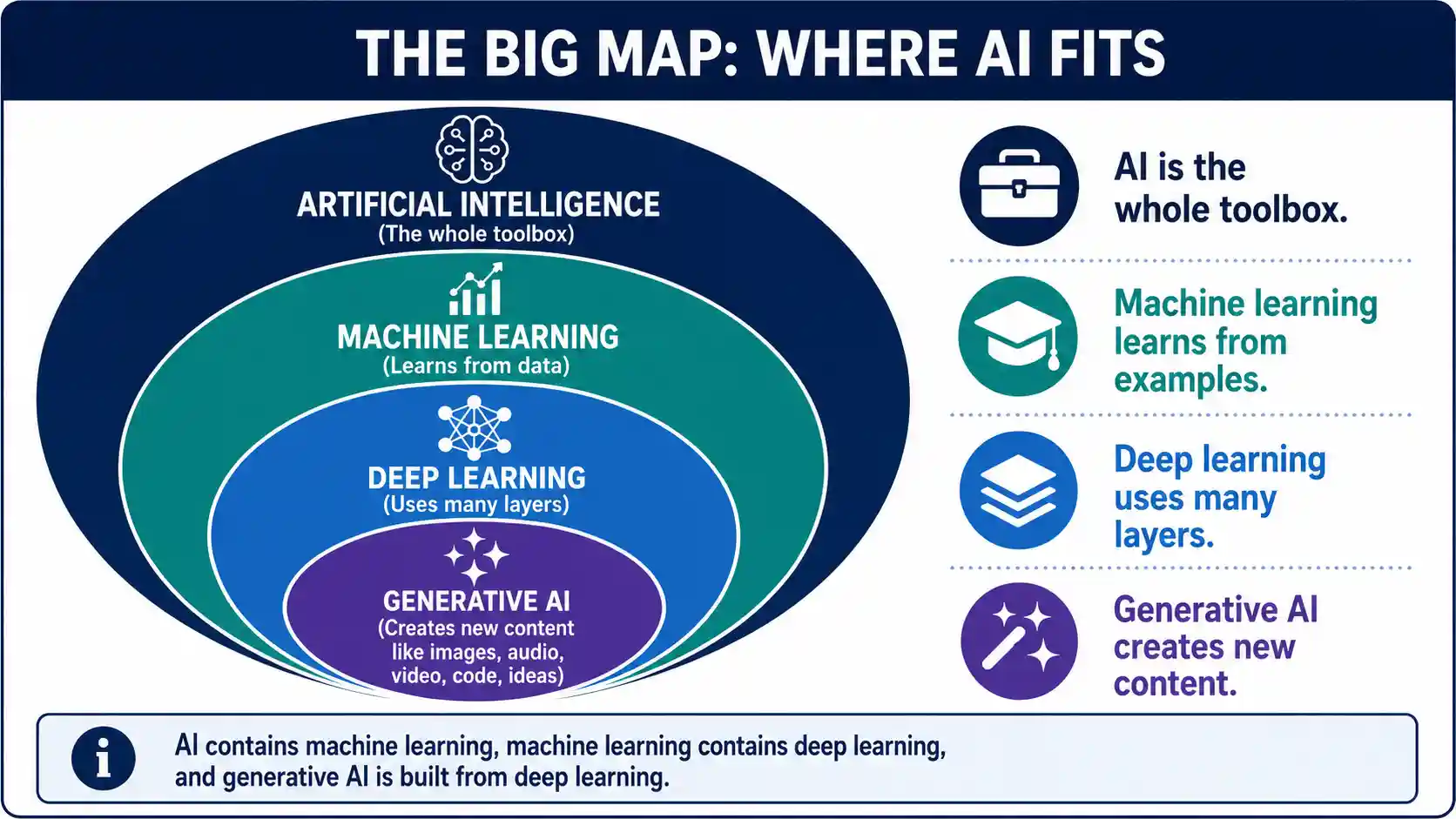
AI is the broad category. Machine learning is one part of it. Deep learning is a layer inside machine learning. Generative AI is the part most people interact with every day through tools like ChatGPT, Copilot, Gemini, Claude, Canva, and Perplexity.
This matters because businesses often talk about AI as if every tool does the same thing.
They do not.
Some tools are good at writing. Some at reading documents. Some at making images. Some at searching across information. Some at summarizing calls. Some at connecting to systems and completing multi-step workflows.
If a team does not understand the map, they will either overestimate AI or underestimate it. They may expect a chatbot to replace a trained professional. That is a mistake. They may dismiss AI because one tool gave them a weak answer. That is also a mistake.
The better question is not "Should we use AI?" The better question is: which AI capability fits which business problem, for which team, under which rules, with what review process?
The first question we answer with every client.
That question changes everything. It is also where every engagement we run begins.
Part 2: The Five Layers Every AI Project Needs
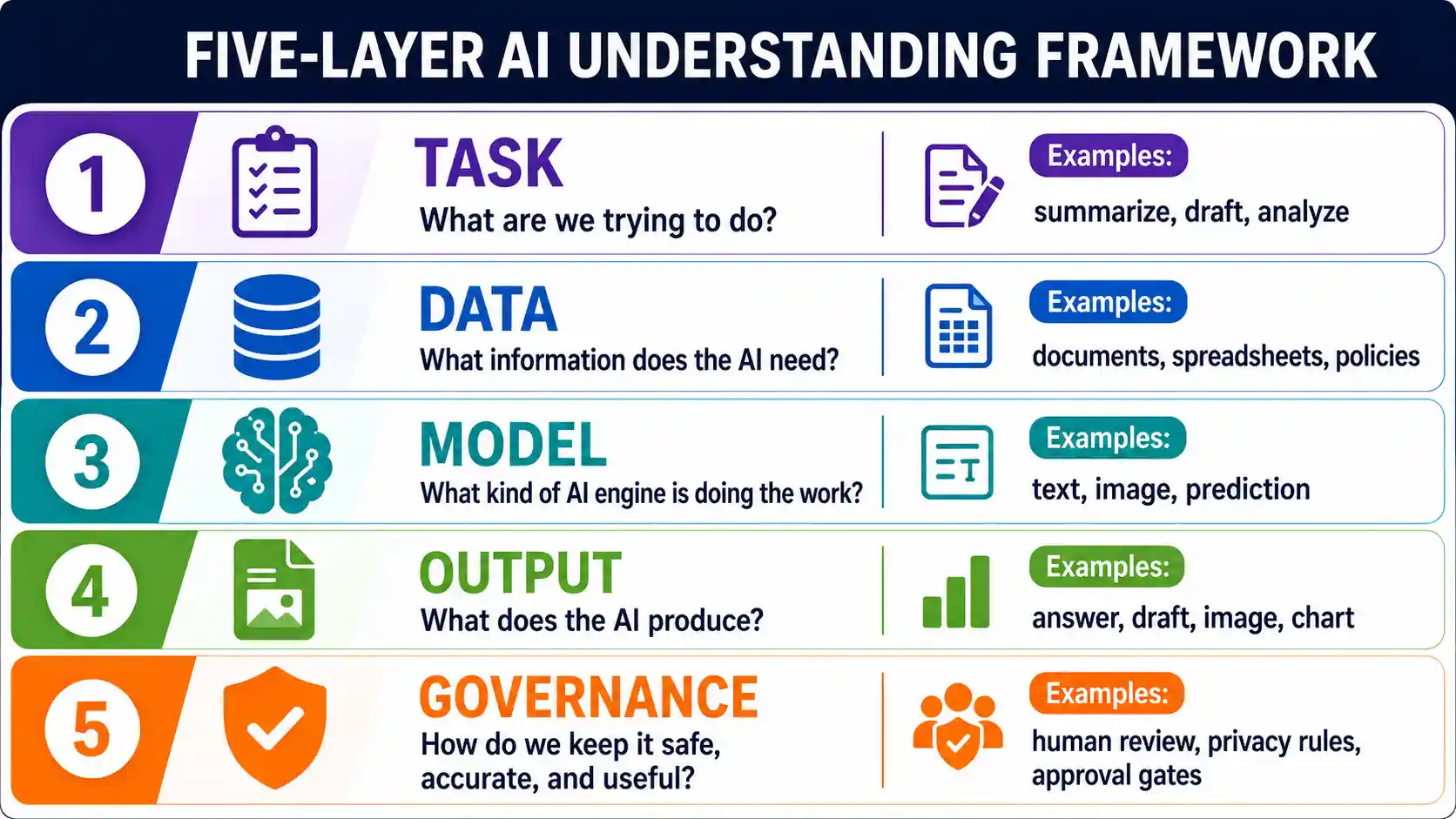
We work in five layers: Task. Data. Model. Output. Governance.
Most AI failures happen because one of those layers is ignored.
A team jumps straight to a tool without defining the task. Or they write a prompt without giving the AI enough context. Or they use the output without review. Or they paste sensitive information into the wrong system. Or they never decide who owns the process.
A good AI strategy connects all five. Our custom playbooks are built on this framework. The depth lives in the work we do together, not on the surface of the diagram.
Where this usually breaks first
In small and mid-market businesses, the most common breakdown is between Data and Governance. Teams have plenty of useful data and plenty of useful tasks. They do not have a clear rule for which data is allowed in which tool, who reviews outputs before they leave the building, and what happens if something goes wrong. That is the gap we close first.
Part 3: AI Is a Team Member. Not the Boss.
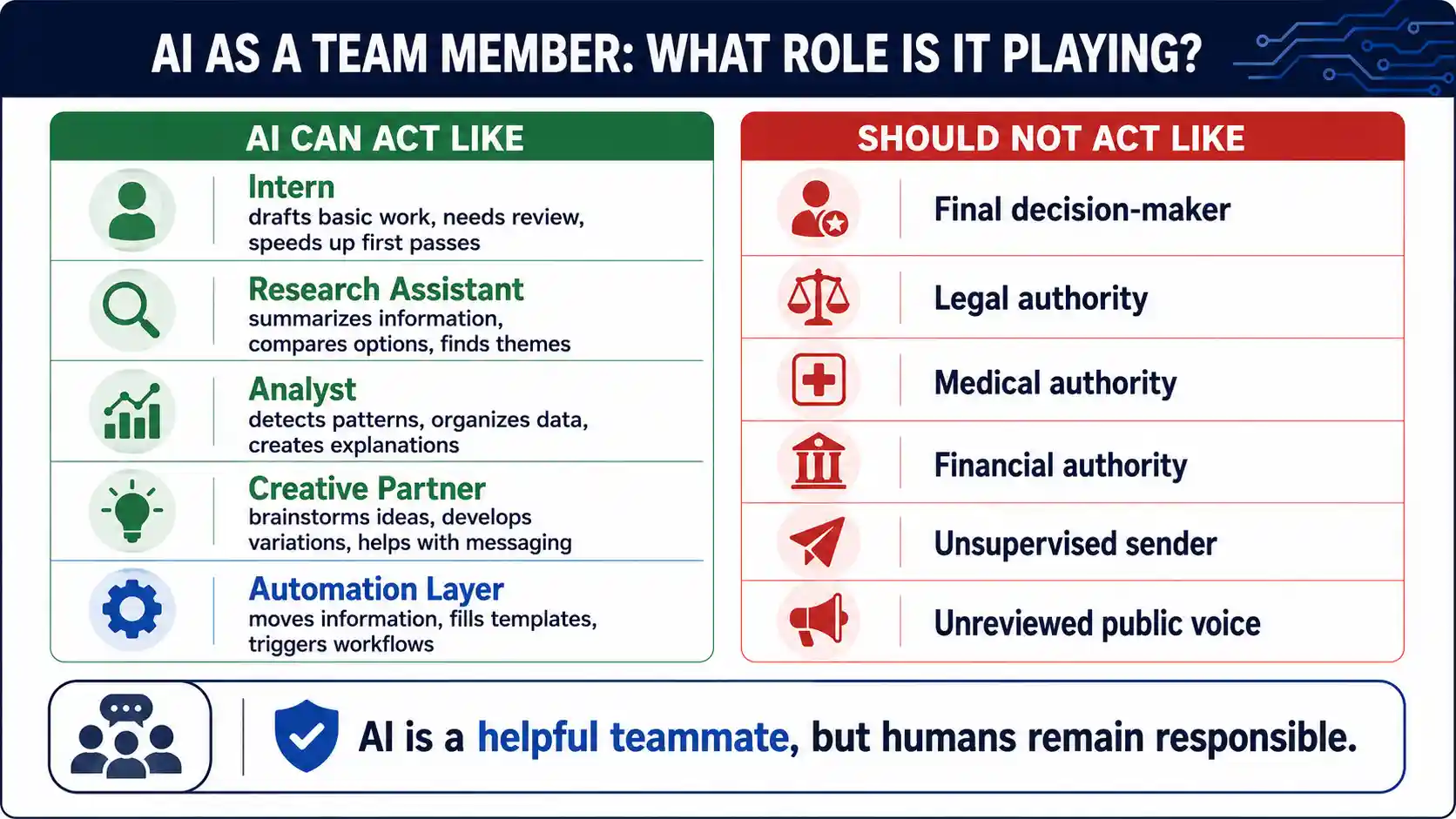
One of the most useful ways to teach AI is to compare it to roles on a team.
AI can act like an intern that drafts work for review. A research assistant that summarizes information and finds themes. An analyst that organizes data and creates explanations. A creative partner that brainstorms variations. An automation layer that moves information and triggers workflows.
But AI should not act like the final decision maker. It should not act like your legal authority, medical authority, or financial authority. It should not be an unsupervised sender or an unreviewed public voice.
The best AI users are not the people who blindly trust the tool. They are the people who know exactly what role the tool is playing at any given moment.
That is where good training makes a difference.
Part 4: Where You Are on the AI Maturity Curve
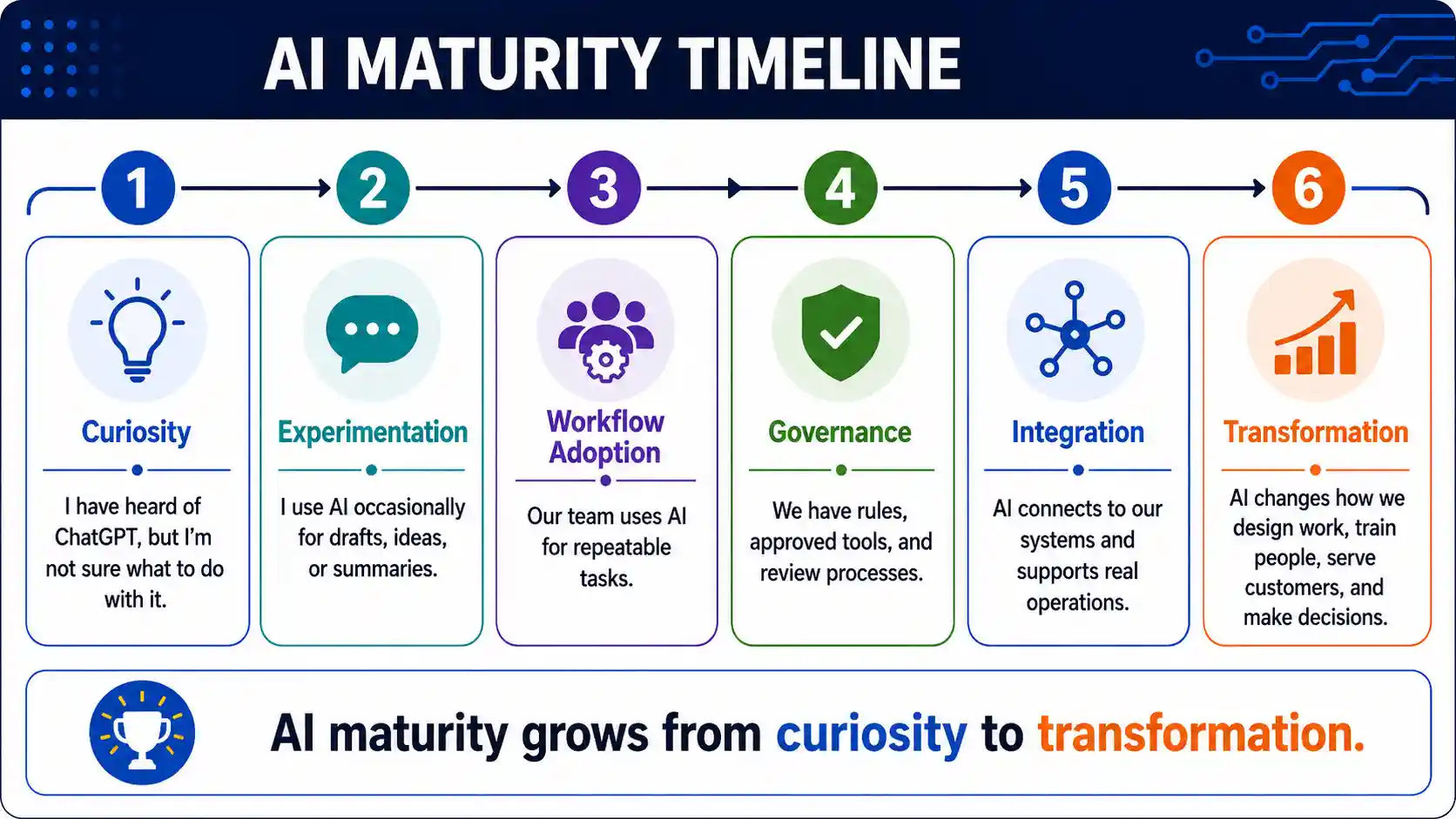
Every business is at a different stage of AI maturity. There are six.
1. Curiosity
"I have heard of ChatGPT, but I am not sure what to do with it."
2. Experimentation
"I use AI occasionally for drafts, ideas, or summaries."
3. Workflow Adoption
"Our team uses AI for repeatable tasks."
4. Governance
"We have rules, approved tools, and review processes."
5. Integration
"AI connects to our systems and supports real operations."
6. Transformation
"AI changes how we design work, train people, serve customers, and make decisions."
Most of the companies we meet are honestly at stage 2 or 3. A handful of people are using tools, but there is no shared process, no governance, and no clear connection to business outcomes.
A company does not jump from curiosity to transformation in one workshop. It moves through the stages intentionally. People need clarity first. Then confidence. Then repeatable workflows. Then governance. Then integration. Then the redesign of larger systems of work.
That is the difference between scattered experimentation and real AI strategy. It is also the difference between buying tools and getting outcomes.
Self-locate: where are you on the curve?
If you are honestly at stage 2 or 3, you are exactly where we work best. We meet teams where they are. We do not push them through theory. We move them through the stages with real work on real bottlenecks.
If you are at stage 1, the right next step is usually a half-day strategy session before any team training. If you are at stage 4 or 5, the right next step is a fractional AI leadership engagement so the work compounds instead of stalling. Either way, the path forward is structured.
Part 5: Safe AI Use Is Not Optional
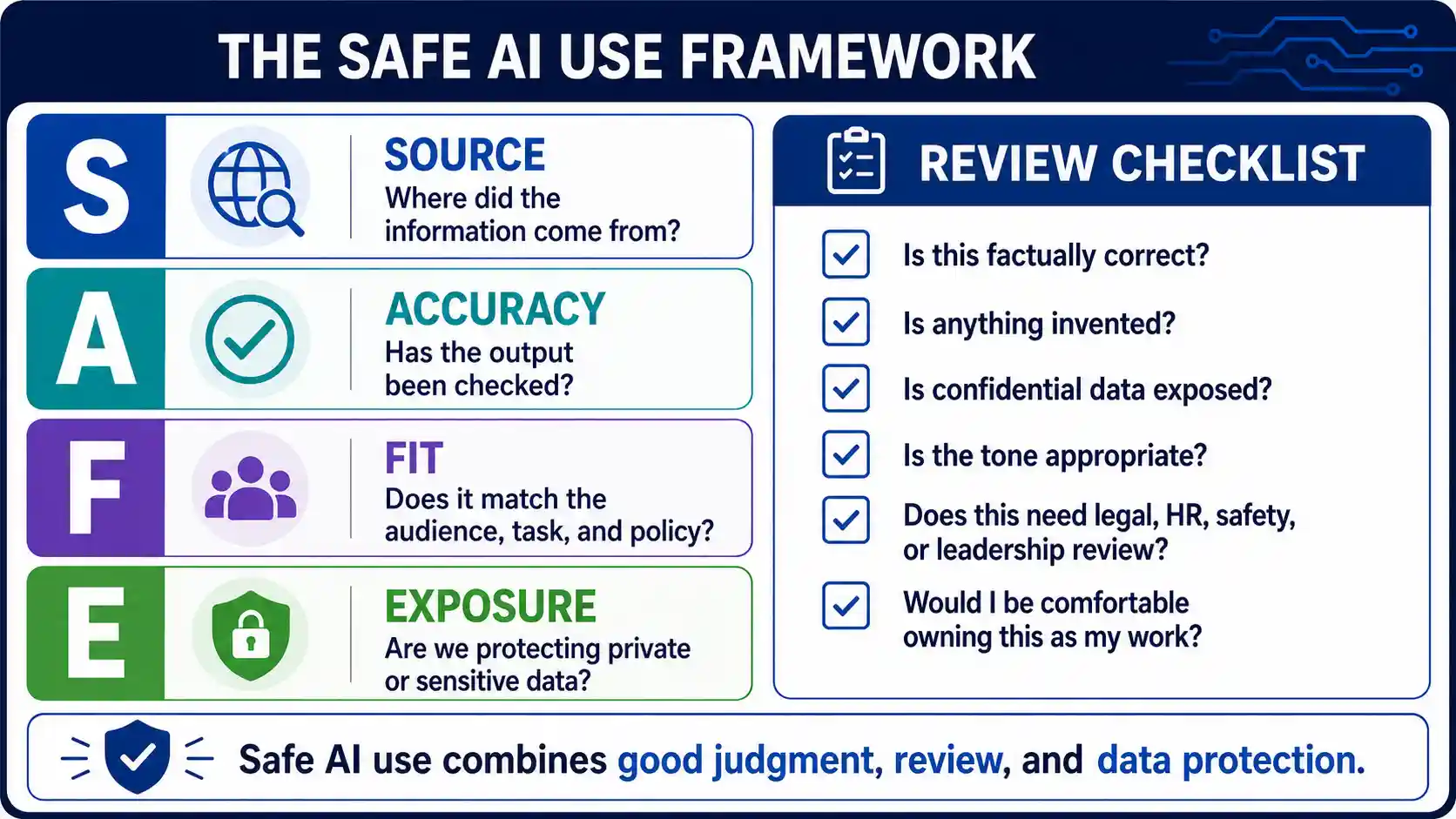
Every serious AI program needs a governance layer. We teach a simple framework called SAFE.
S. Source.
Where did the information come from? Can you trace it? Is it allowed?
A. Accuracy.
Has the output been checked against the real numbers, the real policy, or the real source? By whom?
F. Fit.
Does this match the audience, task, brand, policy, and situation?
E. Exposure.
Are we protecting private or sensitive data? What gets logged? What never leaves the building?
It looks simple on a slide. The depth is in the review habits we install with teams. When to require legal or HR review. What data never leaves the building. How to handle confidential client information. Which tools are sanctioned and which are not. What gets logged. Who owns each step.
Most companies skip this part. Then they wake up to a privacy incident, a brand-tone mistake in a customer-facing message, or an AI-generated document quietly used to make a real decision without review.
Governance is what separates AI as a novelty from AI as a business capability.
Part 6: The Complete Blueprint
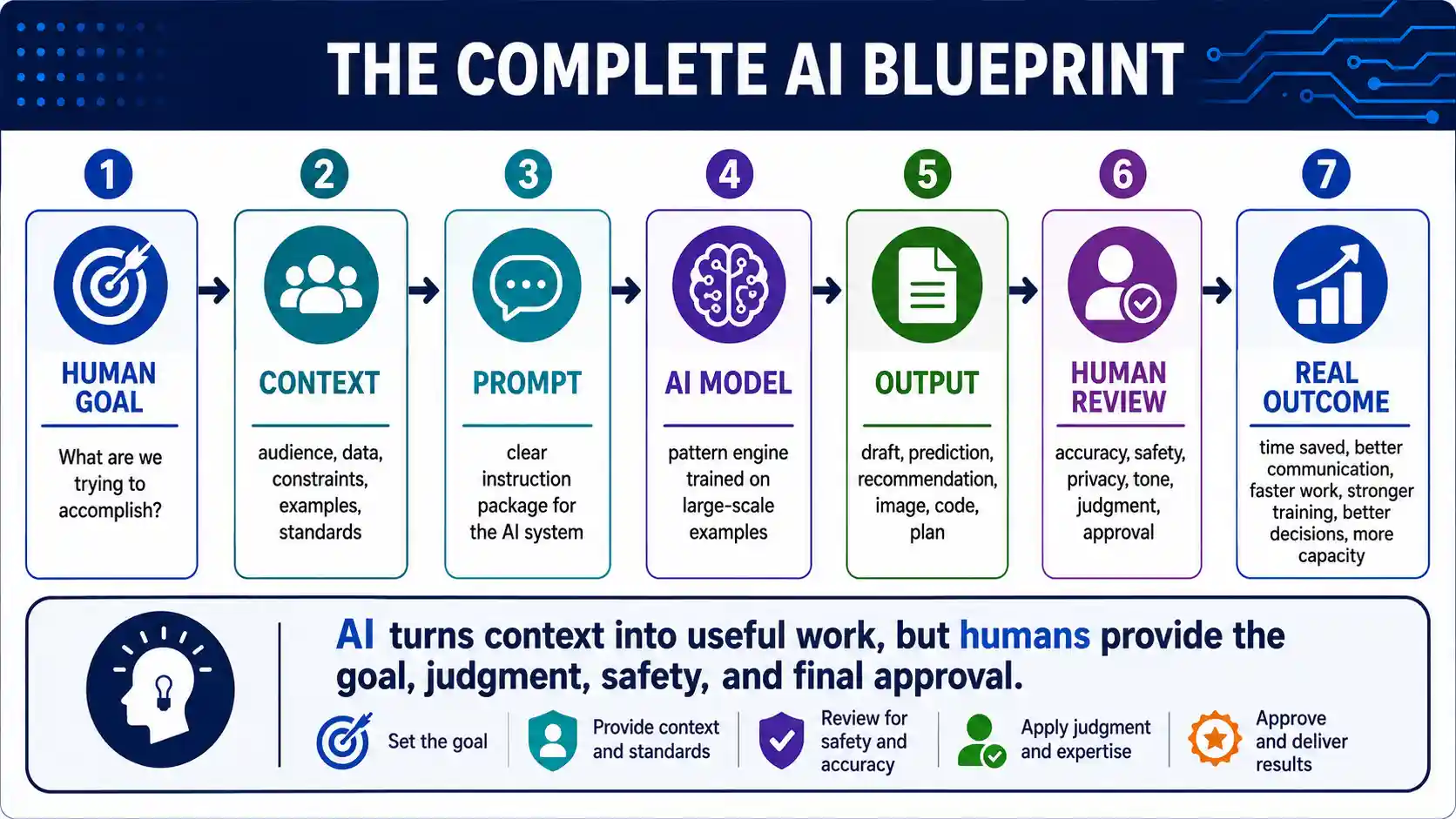
When the framework comes together, the blueprint reads like the diagram at the top of this article.
A human goal starts the process. Context gives the AI direction. A clear prompt packages the request. The AI model generates an output. Human review checks the work. The real outcome creates value. The workflow is saved, refined, and repeated.
AI turns context into useful drafts, predictions, and actions. Humans provide the goal, judgment, safety, and final approval.
When a business understands that, AI stops feeling like a threat or a toy. It becomes a practical operating advantage.
Part 7: What This Looks Like in Your Industry
We build custom playbooks. The framework stays consistent. The work is industry-specific.
Manufacturing Teams
SOPs, QA reports, maintenance summaries, and safety checklists move from hours to minutes. We hold the line on internal standards while cutting documentation time significantly.
Marketing Teams
Content calendars, blog outlines, email campaigns, and brand-consistent variations at scale. Teams stop fighting blank-page work and start shipping a month of content in an afternoon.
Finance Teams
Variance narratives, board summaries, vendor communications, and plain-language explanations of financial data, drafted in a fraction of the time.
Estimating & Proposal Teams
RFP summaries, scope drafts, bid comparisons, and client-ready proposal language. Three times faster on scope writing is realistic.
Sales & Customer Service
Follow-ups, call summaries, CRM notes, and objection responses. Admin time drops. Relationship time rises.
HR & Learning Development
Onboarding materials, policy explanations, training guides, and microlearning content, without losing voice or compliance.
Operations & Admin
Meetings turned into action items. SOPs built four times faster. Cleaner internal communications across the board.
The work changes by department. The pattern stays the same: find the friction, design the workflow, train the team, add guardrails, review the output, measure the impact, improve the system.
Part 8: Why We Don't Sell Slide Decks
There are hundreds of AI tools fighting for attention and budget. New ones appear every week. Some are useful. Some are overbuilt. Some create more problems than they solve.
That is why tool selection should come after strategy.
A tool alone does not create adoption. People create adoption.
Managers create adoption when they know which workflows to reinforce. Employees create adoption when they understand how AI helps their role. Leadership creates adoption when they tie AI use to business goals. Governance creates adoption when people know what is allowed, what is not, and when review is required. Training creates adoption when people practice on work that actually matters.
A generic slideshow can explain what AI is. It does not change behavior.
People need to use the tools. Write prompts. Test outputs. Review mistakes. Improve workflows. Leave with practical assets they can use the same day.
That is the work we do. That is why our clients keep us.
The Bottom Line
Most businesses are not behind on AI. They are unstructured.
The businesses that win with AI will be the ones that learn how to connect AI to real workflows, train their teams hands-on, protect their data, review outputs responsibly, and turn scattered experiments into repeatable business systems.
AI is not magic. It is pattern work.
Used well, it becomes a practical operating advantage.
That is the work. Helping companies move from curiosity to confidence, from scattered experiments to structured adoption, and from AI hype to real business outcomes.
Let's get yours moving.
Industry Research and Adoption Data
- McKinsey & Company (2026): "The State of AI." Adoption, ROI, and pilot success data for enterprise and mid-market AI programs.
- Adecco Group (2025): Global Workforce of the Future Report. Findings on worker AI training rates and productivity savings.
- Microsoft, BCG, and McKinsey (2025 to 2026): Supporting data on leadership AI engagement and workflow redesign as predictors of AI ROI.
Foundational Concepts
- IBM, "What is artificial intelligence?" and "AI vs. machine learning vs. deep learning vs. neural networks."
- IBM, "What is generative AI?"
Governance and Risk
- NIST AI Risk Management Framework. Foundational reference for AI governance, accountability, and risk management practices.
Companion Articles from Understanding Your AI
Where does your team stand with AI?
Four questions, about a minute. The free Team Readiness Check tells you whether your team is at the starting line, stalled, or ready for more, and what to do first. Every team workshop that follows ends with a 30-day adoption report.