Short answer: Mostly neither. The bulk of AI training data is copyrighted content crawled from ordinary, publicly accessible web pages. Public domain material, like digitized old books and US government records, is real but a much smaller share, and a separate slice came from pirated book libraries, which is where the courts and a $1.5 billion settlement have landed.
Verified as of November 17, 2026. I teach AI for a living, but I am not a lawyer, and nothing here is legal advice.
You have probably heard that AI was built on stolen content. My own answer to that for a long time was that most of what these models learned from was public domain: old books, government documents, Wikipedia. So I put that belief to the test. I went through the research papers and court records and checked every claim against its original source. I was half right, and the half I got wrong turned out to be the more useful part for anyone running a business.
Is most of the internet public domain?
No, and the reason is a rule most business owners have never been told. In the United States, copyright attaches automatically the moment an original work is fixed in a tangible form. Registration and a (c) symbol are optional, according to the US Copyright Office.
Picture a bakery in Midland that posts a page about its cinnamon rolls. The moment that page goes live, the owner holds the copyright. No form, no fee, no symbol. The same goes for every forum comment, product description, and blog post written since the internet went mainstream.
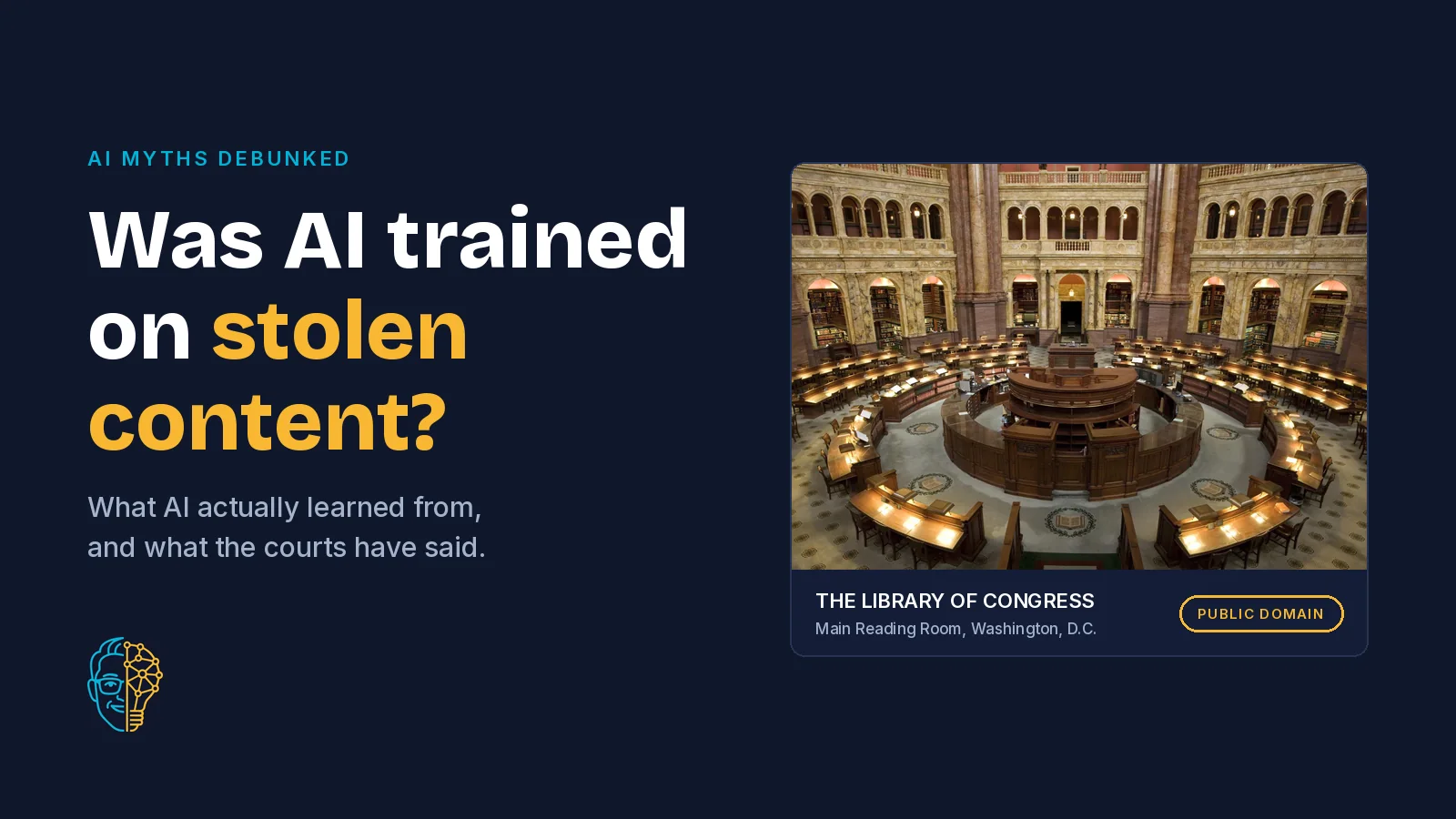
The internet does hold a genuine public domain, though, and this is where my instinct had a point. On January 1, 2026, works first published in 1930 entered the US public domain, according to Duke's Center for the Study of the Public Domain. Older books, newspapers, and records have been scanned and posted by the millions, and HathiTrust alone offers about 7 million full-view public domain volumes. Works created by the US federal government are public domain too. Even inside a copyrighted article, the facts themselves belong to nobody.
The problem is size. AI builders measure text in tokens, which are small chunks of words. The public domain portion of Common Corpus, one of the largest public domain text collections assembled for AI, holds about 1.14 trillion tokens of digitized books, newspapers, and government records. FineWeb, a single filtered dataset built from snapshots of the open web, holds 15 trillion. For every page in that public domain collection, one web dataset holds about thirteen pages of content created for the internet, and nearly all of it is copyrighted.
What did AI companies actually train on?
The biggest labs do not fully say. Meta describes the 15 trillion tokens behind Llama 3 as "collected from publicly available sources," which tells you the text was reachable, not that it was free to use. OpenAI was more direct with the UK House of Lords in a December 2023 submission: "it would be impossible to train today's leading AI models without using copyrighted materials."
Where a training mix has been published in detail, public domain is a minority. The Pile, a well-documented research dataset, is about 10.5% public domain and US government material by raw size, by my count of its components. One collection of pirated-origin books inside that same dataset, Books3, makes up 12.2% on its own. GPT-3's published mix was 60% filtered web crawl, with Wikipedia at 3%.
People have tried building AI on clean data only. The Common Pile project assembled about 8 terabytes of openly licensed and public domain text, and its authors wrote that only "a small fraction of content on the web is distributed under open licenses." Models trained on it held their own against older open models of similar size but trailed newer models trained on far more data. Clean training data exists. There just is not enough of it to build the tools most people use every day.
Was AI trained on stolen content?
Partly, but "stolen" lumps three different things together.
Most of the copyrighted text was crawled from pages anyone with a browser could open. Think of it as reading a menu taped to that Midland bakery's window. Whether you can then copy the menu into your own product is a real legal question, but it is a different act from breaking in the back door.
A smaller slice really did come through the back door. In Bartz v. Anthropic, the court record describes more than 7 million pirated books downloaded from shadow libraries including LibGen and Books3. Meta faces similar allegations in its own lawsuit. This is where "stolen" fits best, and it is where the money has moved.
A third slice was paid for. The Wall Street Journal reported News Corp's deal with OpenAI at $250 million over five years, and Reuters reported Reddit's deal with Google at about $60 million a year. Nobody has published how much of any model's training data came through deals like these.
One more piece works in AI's favor. Copyright protects expression, not facts. Under Section 102(b) of the Copyright Act and the Supreme Court's Feist decision, nobody owns the fact that Saginaw sits on the Saginaw River, even when it appears in a copyrighted article. The legal fight is over copying the whole protected text to learn those facts, and over models that memorize and repeat protected text word for word.
| Type of content | Example | Where it stands |
|---|---|---|
| Public domain | US books published in 1930 or earlier, federal records | Free to use. The limit is volume. |
| Openly licensed | Wikipedia (CC BY-SA) | Still copyrighted, shared with conditions |
| Licensed by deal | News Corp and OpenAI | Paid for under contract |
| Crawled but copyrighted | Ordinary business and news websites | Unsettled. Two federal trial courts called training fair use. |
| Pirated | Books3, LibGen | The clearest legal problem. Led to a $1.5 billion settlement. |
What have courts decided?
Courts have mostly separated how the content was obtained from how it was used. In June 2025, Judge William Alsup ruled in Bartz v. Anthropic that training on books was fair use, calling the use transformative, "spectacularly so," but refused to extend that to the pirated library. Anthropic settled for $1.5 billion, roughly $3,000 per book across about 482,000 works, with final approval in July 2026. Two days after Alsup's ruling, Judge Vince Chhabria ruled for Meta in a similar case, while warning that the decision meant only that those authors "made the wrong arguments."
The only federal appeals ruling on AI training went the other way. In September 2026, the Third Circuit held that ROSS Intelligence's use of Thomson Reuters legal summaries to build a competing search tool was not fair use, though that case involved non-generative AI. In Germany, a Munich court ruled in November 2025 that OpenAI's model memorizing song lyrics infringed copyright. The New York Times case against OpenAI has not reached a fair use ruling. The law is unsettled, and the piracy cases are the ones that have cost real money.
Does trademark matter here?
Very little. Trademark protects brand identifiers like your business name and logo from customer confusion. Copyright does not cover names, titles, or slogans at all, according to the Copyright Office's Circular 33. An AI reading a page that mentions your bakery's name is not a trademark problem. Trademark mostly shows up on the output side, as in Getty Images' UK case against Stability AI over Getty watermarks appearing in generated images.
What does this mean for your business?
Your website content is copyrighted the moment you publish it. Your service pages, blog posts, and staff bios are protected. That protection does not stop anyone from reading them, and that includes AI crawlers.
"Publicly available" does not mean "public domain." A flyer stapled to a telephone pole is public, but you still cannot photocopy a thousand of them and sell them as your own. The Copyright Office makes the same point: "publicly available" is not the same as "authorized," and may only mean "available on the internet."
You do have some say going forward. A robots.txt file can tell AI crawlers to stay out. By the end of 2023, 79% of top US news sites were blocking OpenAI's crawlers, according to the Reuters Institute. Cloudflare asks new customers whether to allow AI crawlers, and more than a million of its customers had turned on its one-click block as of July 2025. A block only applies from the day you add it. It does not pull your pages out of data that was already collected.
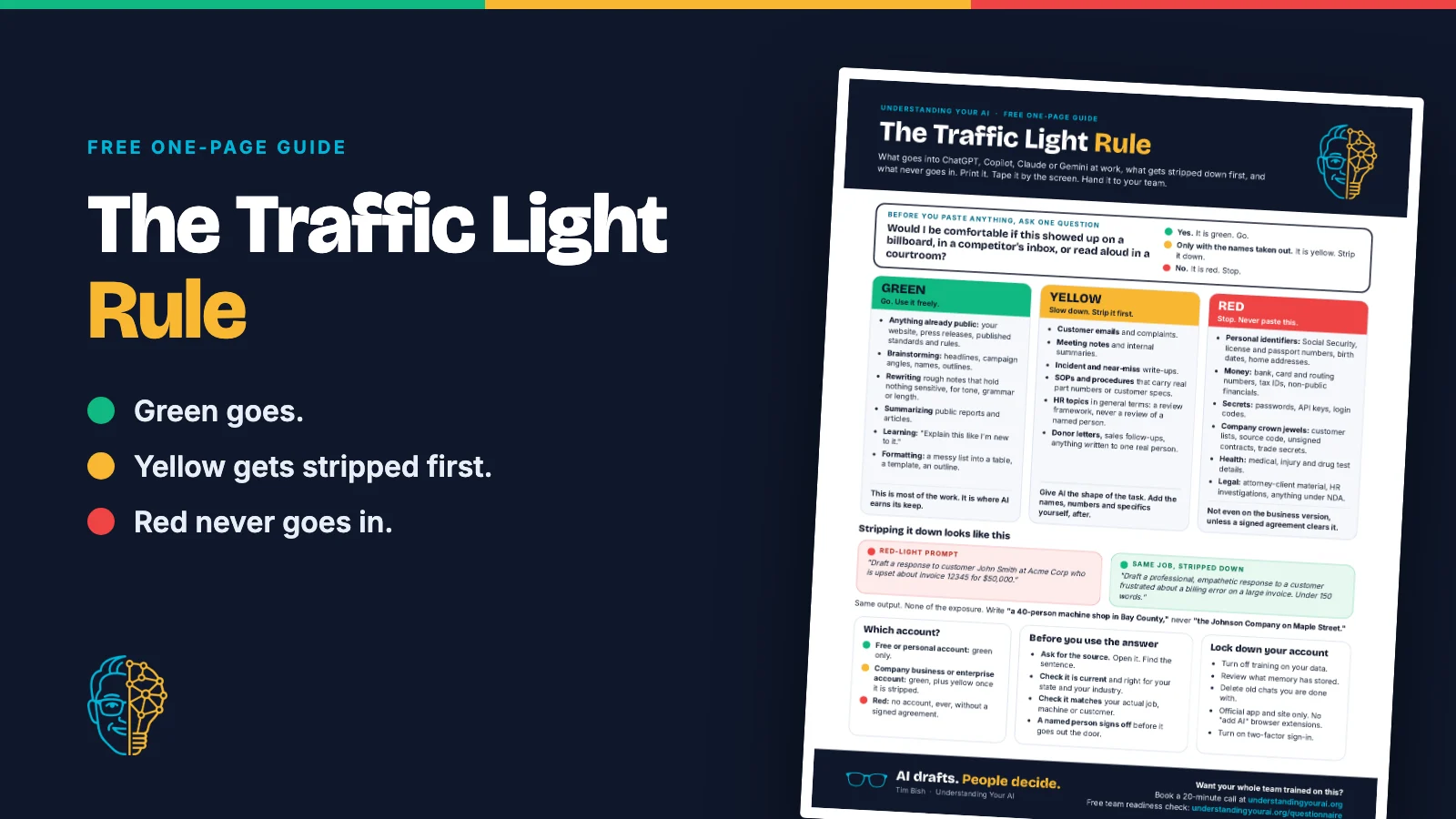
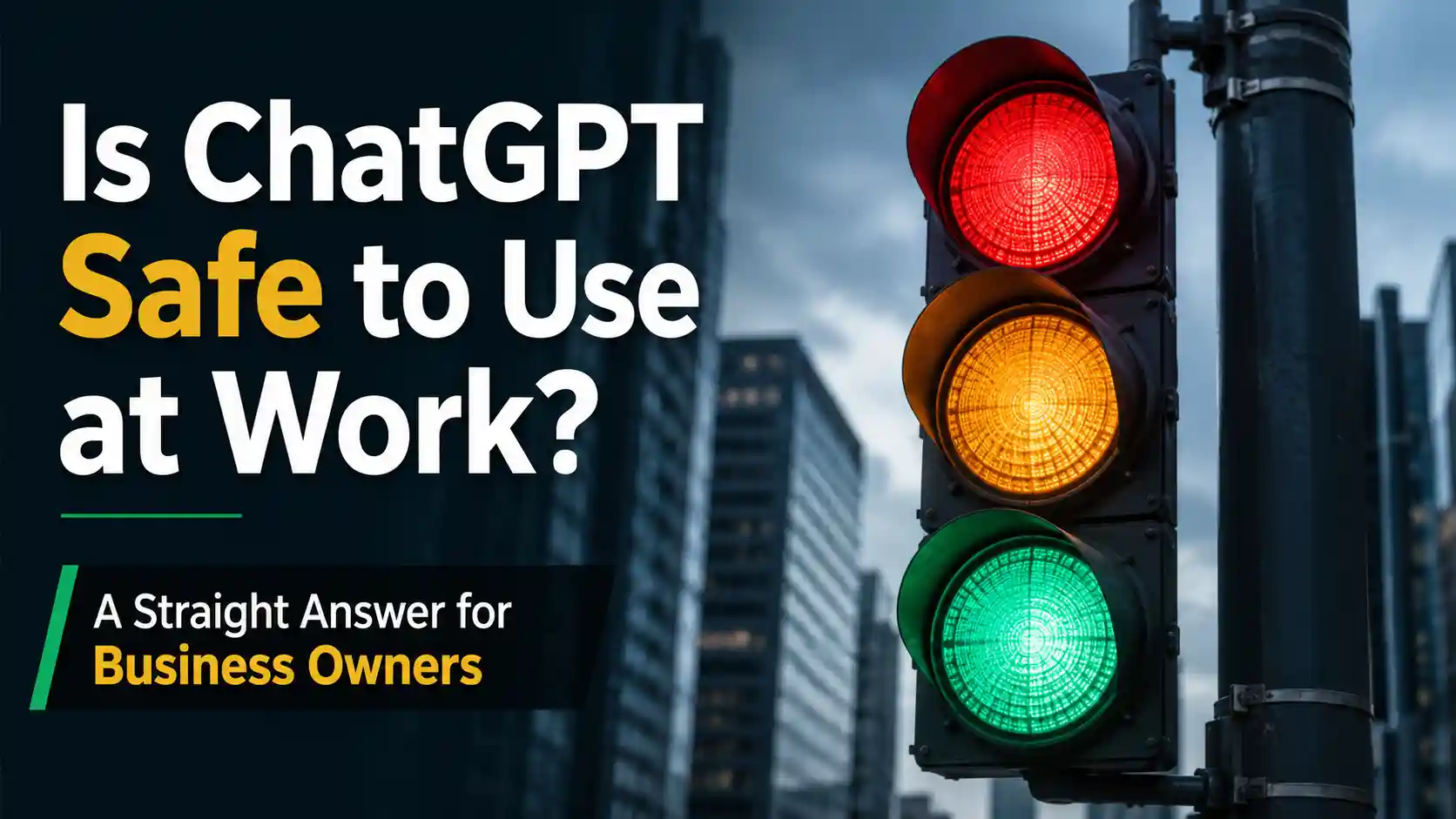
In my workshops I teach the Traffic Light Rule for what goes into an AI tool: green for content that is safe to share, yellow for content that needs identifying details stripped first, and red for content that never goes in. This research is the same rule running in the other direction. Treat anything on a public web page as green, because a crawler can read it whether you like it or not. If something on your site would be a yellow or red item in a chat window, it should not be sitting on a public page either.
Common questions
Is AI trained more on public domain content or copyrighted content?
Copyrighted content. Where training mixes are published, public domain is a minority, about 10.5% of The Pile by raw size, and the largest public domain collections are a fraction of the size of a single web dataset.
Is everything on the internet copyrighted?
Almost everything created for it is, automatically, with no registration or (c) symbol needed. The exceptions are older works that have been digitized, US federal government material, and works their creators dedicated to the public domain.
Was AI trained on stolen content?
Partly. Most copyrighted text was crawled from publicly accessible pages, a smaller slice came from pirated libraries like Books3 and LibGen, and some was licensed through paid deals.
Is training AI on copyrighted content legal?
Unsettled. Two US federal trial courts found training fair use in 2025, a federal appeals court ruled against a non-generative legal AI tool in 2026, and the New York Times case against OpenAI has not reached a fair use ruling.
What is the difference between publicly available and public domain?
Publicly available means anyone can access it. Public domain means no one owns the copyright. Most publicly available online content is still copyrighted.
Can I stop AI companies from using my website?
You can ask crawlers to stay out going forward with robots.txt or with settings from providers like Cloudflare. That does not remove content from datasets that were already collected.
Sources
- US Copyright Office, Circular 1, Copyright Basics
- Duke CSPD, Public Domain Day 2026
- HathiTrust, copyright review reaches one million items
- 17 U.S.C. 105, Cornell Legal Information Institute
- Common Corpus (arXiv 2506.01732)
- FineWeb (arXiv 2406.17557)
- Meta, Introducing Llama 3
- OpenAI written evidence to the House of Lords, reported by Computerworld
- The Pile (arXiv 2101.00027)
- Language Models are Few-Shot Learners, GPT-3 (arXiv 2005.14165)
- The Common Pile v0.1 (arXiv 2506.05209)
- Bartz v. Anthropic, summary judgment order, June 23, 2025
- Bartz v. Anthropic, final approval order, July 20, 2026
- Anthropic Copyright Settlement official site
- Skadden, Fair use and AI training: two recent decisions
- Reuters via The Star, Third Circuit upholds Thomson Reuters win
- WIPO, GEMA v. OpenAI summary
- Authors Guild, summary judgment motion in the OpenAI litigation
- Engadget, OpenAI and News Corp deal (citing WSJ)
- Reuters via The Star, Reddit and Google licensing deal
- 17 U.S.C. 102, Cornell Legal Information Institute
- Feist Publications v. Rural Telephone Service, 499 U.S. 340 (1991)
- US Copyright Office, Circular 33, Works Not Protected by Copyright
- Cleary Gottlieb, UK High Court ruling in Getty Images v. Stability AI
- US Copyright Office, Generative AI Training report, pre-publication version
- Reuters Institute, How many news websites block AI crawlers
- Cloudflare press release on AI crawler controls, July 1, 2025
Want your team to work through this?
Tim teaches teams across Michigan's Great Lakes Bay Region what goes into AI tools, what AI takes from your website, and how to use both on purpose. Start with a 20-minute call or the free readiness check.