Verified as of October 2, 2026. The Michigan deadlines, fees and appeal rules below were read against the statute text at legislature.mi.gov on that date (MCL 15.231 through 15.244). Other states run on different clocks. The letter itself works in all of them.
To find out what your town's license plate readers or other AI cameras are doing, send a public records request to the agency that runs them. Ask for the contract, the camera locations, the data-sharing agreements, the retention policy and the search audit logs. In Michigan the agency has five business days to answer. The letter is below, and it is free: copy it, fill in the brackets, send it.
Free · No signup · Updated October 3, 2026
Get the records request letter
One letter covers license plate readers, facial recognition and any other AI camera system. Copy it into an email, or download it and attach it.
- Michigan: the public body has five business days to answer. The deadlines, fees and appeal steps are below.
- Every other state: the same letter works. Put your state's public records law where the bracket says so.
The short version
- Public money, public record. Every license plate reader, facial recognition contract and "AI camera" on a public street was bought by a public body. The contract, the camera map, the sharing list, the retention period and the search counts are records you can ask for.
- No lawyer, no reason, no badge. You need one letter and a calendar. Michigan does require your complete name, mailing address, and a phone number or email address in the request.
- Ten minutes to send. Pick the public body, find its FOIA coordinator, paste the letter, write down the date.
- Five business days. That is how long a Michigan public body has to answer, plus one extension of up to ten more. Silence past the deadline counts as a denial, and a denial can be appealed.
- Read three things first. How long scans are kept, who else can search, and how outside searches compare with local ones.
Are police camera records public?
Yes. Every license plate reader, facial recognition contract and "AI camera" on a public street was bought with public money by a public body. That makes the paperwork a public record: the contract, the camera locations, who else can search the data, how long it is kept, and how many times it was searched. You do not need a lawyer, a reason, or a journalist's badge. You need one letter and a calendar.
Some pieces can be withheld under specific exemptions, and one category, the audit log held on the vendor's servers, is being fought over in a Michigan court. The push-back section covers both.
It works. In East Lansing, a records request produced a 1,700-page release showing the police department's Flock data being searched by dozens of other Michigan departments across a 30-day stretch.1 In Pflugerville, Texas, a resident's request for the city's Flock audit records showed roughly 315 outside searches for every one run by the city's own police.1 In Ferndale, a city council member audited the city's own logs, and Ferndale ended its contract on November 13, 2025.1
Once officials read their own records, things move. Dayton, Ohio found more than 7,000 immigration-related searches of its Flock data by outside entities, suspended the program, and covered all 72 of its cameras.2 In South Lyon, residents raised privacy concerns at a council meeting on September 14, 2026. Two weeks later the council voted 5 to 2 not to renew its contract, and police covered both cameras that night.3 Lansing's council passed a non-binding resolution, 7 to 1, in August 2026 asking the mayor and police to end the city's Flock contracts.4
The scale is why it matters. Flock Safety, the vendor in most of these stories, says its network includes more than 120,000 cameras across 49 states.5 More than 180 Michigan agencies use Flock, and most of those communities have never pulled their own audit.1 For what the cameras do and who can search them, read A Field Guide to the Flock.
What records should you ask for?
Seven kinds of records. The letter asks for all of them, by number, so a records officer can answer item by item.
| Record | What it tells you |
|---|---|
| 1. Contracts, purchase orders, renewals and invoices | What the system costs, how long the contract runs, and what it says about who owns the data. |
| 2. Camera locations and install dates | Where the cameras are and when each one went up. |
| 3. Policies, procedures and training materials | The retention period, and the rules for hot lists, alerts and searches. |
| 4. Data-sharing agreements and access lists | Which other agencies, private entities or the vendor can search your town's data. |
| 5. Audit logs and usage reports | How many searches, alerts and hits there were. For Flock systems, the network audit is the document that lists outside organizations and their search counts. |
| 6. Council or board minutes and votes | Who approved the purchase or renewal, and when. |
| 7. Complaints and corrections | Whether the system has produced misidentifications, wrongful stops or corrections. |
Who do you send the request to?
Send it to the FOIA coordinator of the public body that runs the cameras. That is the police department, the city or township, the county sheriff, or the school district. It takes about ten minutes.
- Pick the public body. If you are not sure who owns the cameras, send the same letter to the city and to the county. In Michigan, any employee who receives a request has to forward it promptly to the FOIA coordinator.
- Find the FOIA coordinator. Search "[city] FOIA coordinator" or "[county] records request". Michigan public bodies have to post their FOIA procedures on their website if they have one. Most accept requests by email or a web form, and email gives you a timestamp.
- Name the vendor if you can. Flock Safety, Motorola (Vigilant), Axon (Fusus), Genetec, Rekor, Verkada, Clearview AI. If you do not know, the letter asks for "any vendor" and that is enough.
- Put your name and address on it. Michigan requires your complete name, your mailing address, and a phone number or email address in the request.
- Write down the date you send it. Every deadline is counted from it.
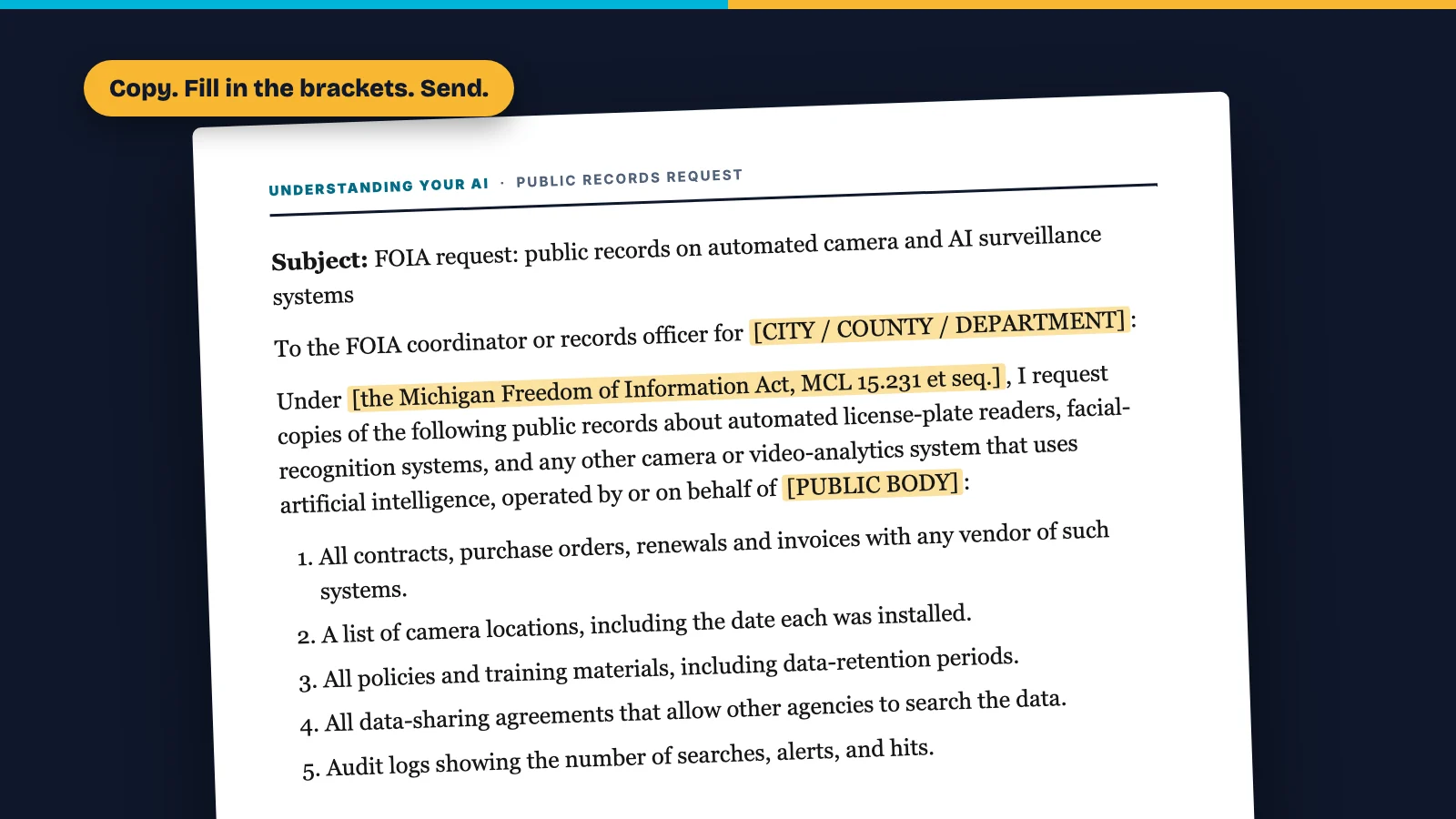
The records request letter
Copy it, fill in the bracketed parts, and send it as the body of an email, or download it and attach it. Keep "FOIA request" in the subject line. In Michigan, a request that clearly identifies itself that way becomes a denial you can appeal if the deadline passes with no answer.
Subject: FOIA request: public records on automated camera and AI surveillance systems
To the FOIA coordinator or records officer for [CITY / COUNTY / DEPARTMENT]:
Under [the Michigan Freedom of Information Act, MCL 15.231 et seq. / your state's public-records law / the federal Freedom of Information Act, 5 U.S.C. § 552 for a federal agency], I request copies of the following public records about automated license-plate readers, facial-recognition systems, and any other camera or video-analytics system that uses artificial intelligence, operated by or on behalf of [PUBLIC BODY] from [DATE, e.g. January 1, 2024] to the date of your response:
- All contracts, purchase orders, quotes, renewals, grant applications and invoices with any vendor of such systems (including but not limited to Flock Safety, Motorola Solutions / Vigilant, Axon / Fusus, Genetec, Rekor, Verkada and Clearview AI).
- A list of camera locations, or the map or spreadsheet the department uses to track them, including the date each was installed.
- All policies, standard operating procedures, and training materials governing use of the systems, including data-retention periods and the rules for "hot lists," alerts, and searches.
- All data-sharing agreements, memoranda of understanding, or network-access settings that allow other agencies, private entities, or the vendor to search [PUBLIC BODY]'s data, and any list of agencies with access.
- Audit logs or usage reports showing the number of searches, alerts, and hits for the period (for Flock Safety systems, this includes the network audit), and any audits or reviews of the system.
- Minutes, agendas, resolutions, or votes of [CITY COUNCIL / COUNTY BOARD] authorizing the purchase or renewal, and any public notice about the installation.
- Any record of complaints, misidentifications, wrongful stops, or corrections involving the systems.
Please send your response and the records by email, in electronic form, where possible. If any part of this request is denied, please cite the specific exemption for each withheld record and release the remainder. I ask that any fee be waived or reduced because furnishing these records primarily benefits the general public and this request is not for commercial use. If fees will exceed $25, please send the itemized estimate and contact me before processing.
Thank you,
[FULL NAME]
[MAILING ADDRESS, required in Michigan]
[EMAIL] · [PHONE]
Sent [DATE]
How long does the agency have to answer?
In Michigan, five business days. A public body has to grant the request, deny it in writing, or send a written notice taking one extension of not more than 10 business days. A request sent by email counts as received one business day after you send it, so start counting on the next business day.
Elsewhere, state deadlines run from about three business days to about a month. Search for "[state] public records act response time". Federal agencies have 20 business days under the federal Freedom of Information Act.9
Michigan at a glance
| Step | The rule | Statute |
|---|---|---|
| What the request must include | Your complete name, mailing address, and a phone number or email address. | MCL 15.233 |
| When the clock starts | A request sent by email counts as received one business day after you send it. If it lands in a spam folder, it is not received until one day after the public body becomes aware of it. | MCL 15.235 |
| Response due | Five business days after the request is received. The public body can take one extension of not more than 10 business days by sending you a written notice. | MCL 15.235 |
| Silence | No answer by the deadline is a final denial when the request plainly identified itself as a FOIA request. This letter does that in its subject line and its first sentence. | MCL 15.235 |
| Fees | Paper copies cost no more than 10 cents a sheet. Labor is capped at the hourly wage of the lowest-paid employee able to do the work, plus up to 50% for fringe benefits. Search and redaction labor can be charged only when not charging would mean unreasonably high costs, and every fee must be itemized. If the estimate tops $50, the public body can ask for a deposit of up to half. | MCL 15.234 |
| Fee waivers | The first $20 is waived for a person who submits an affidavit of indigency, up to twice a calendar year per public body. A public body may also waive or reduce a fee when the records primarily benefit the general public. | MCL 15.234 |
| A late response | On a request that identified itself as a FOIA request, labor charges drop by 5% for each day the response is late, up to 50%. | MCL 15.234 |
| Appeal | Send the head of the public body a written appeal that uses the word "appeal" and says why the denial should be reversed. The head has 10 business days to answer. If the head is a board, the appeal counts as received at its next regular meeting. | MCL 15.240 |
| Court | Or file a civil action in circuit court within 180 days of the final denial. A requester who prevails is awarded reasonable attorney fees and costs. A public body that arbitrarily and capriciously violated the act pays a $1,000 civil fine, plus $1,000 in punitive damages to the requester. | MCL 15.240 |
| Exemptions | Every exemption is listed in one section, and a written denial has to explain which one applies. Exempt material must be separated out and the rest released. | MCL 15.243, MCL 15.244 |
What if they push back?
Four answers come up again and again. Each one has a reply.
What if they ask why you want the records?
You do not have to say. Michigan's Freedom of Information Act gives a person the right to inspect or receive copies of public records, and the request does not need a reason. If the records officer asks you to narrow the request, ask which items are the problem and narrow one at a time. Keep items 1, 2 and 4: the contract, the camera locations, and who else can search.
What if they say it is a security matter?
Ask for the exemption by number. Every exemption a Michigan public body can claim is listed in MCL 15.243, and a written denial has to explain which one applies. Several of the law-enforcement and security exemptions apply only when secrecy outweighs the public interest in disclosure, so say what the public gains from seeing the records. Ask for a partial release: Michigan requires the public body to separate exempt material and make the rest available (MCL 15.244). The trade-secret exemption does not apply to information submitted as a condition of receiving a government contract.
What if they say the vendor owns the data?
Michigan defines a public record as a writing "prepared, owned, used, in the possession of, or retained by a public body in the performance of an official function" (MCL 15.232). Flock's own published position, as of August 13, 2026, is that customers own the data captured by their cameras. The contract in item 1 shows what your town agreed to. Be ready for this answer anyway. Genesee County released its Flock contract but denied the camera locations and the audit logs, saying it did not own the system or the data. The Mackinac Center Legal Foundation filed suit over that denial on August 18, 2026 in Genesee County Circuit Court, so the question is not settled in Michigan. A Field Guide to the Flock has the details. Ask for the denial in writing, then appeal.
What if they do not answer at all?
In Michigan, silence past the deadline is a final denial when the request plainly identified itself as a FOIA request, and this letter does that in its subject line and first sentence (MCL 15.235). That means you can appeal it. A late response also costs the public body: its labor charges drop by 5% for each day it is late, up to 50% (MCL 15.234). Before you appeal, call the office. A request that landed in a spam folder is not counted as received until one day after the public body becomes aware of it.
What should you read first when the records arrive?
Read three things first and you will know more than most council members:
- The retention period. How long every plate scan is kept. Flock's default was 30 days for nine years. On August 13, 2026 the company changed its recommended default to seven days, and existing customers keep the period they already had.6 A policy that says "indefinite" is the story.
- The sharing list. Who else can search. South Lyon's two cameras were open to 14 outside agencies.3 Pflugerville's audit records identified 459 outside organizations.1
- The search counts. Compare searches with alerts and hits, and local searches with outside ones. In Pflugerville the ratio was roughly 315 outside searches for every local one. In Ferndale, the city's own police accounted for less than 1 percent of the searches on its own cameras.1
Then take it to a council meeting during public comment, or send it to a local reporter with the records attached. If you send it to me, I will read it: tim@understandingyourai.org.
Records Request is a Friday segment on the Understanding Your AI YouTube channel, starting October 9, 2026. Each one takes a camera story from the week and the letter that gets its records. The weekly email carries the follow-ups.
Terms used in the letter
- Public records request
- A written request to a government body for copies of its records. Michigan's law is the Freedom of Information Act, so a request there is usually called a FOIA request.
- FOIA coordinator
- The person a Michigan public body designates to accept and process records requests. Other states call the role a records officer or records custodian.
- Automated license plate reader (ALPR)
- A camera system that photographs each passing vehicle, reads the plate, and logs the time and location.
- Retention period
- How long each plate scan is kept before it is deleted.
- Hot list
- A list of license plates the system is set to alert on, such as plates reported stolen.
- Network audit
- For Flock systems, the log that lists outside organizations and their search counts against a town's cameras.
- Transparency portal
- A public web page some departments publish showing how they use the system. It does not show who outside the community is searching it.
Common questions
Do I need a lawyer or a reason to file a public records request?
No. You need one letter and a calendar. Michigan's Freedom of Information Act gives every person the right to inspect or receive copies of public records, with one exception: people serving a sentence of imprisonment. The request does not have to say why you want the records. It does have to include your complete name, mailing address, and a phone number or email address (MCL 15.233).
How long does a Michigan public body have to respond to a FOIA request?
Five business days after it receives the request. It can take one extension of not more than 10 business days by sending you a written notice. A request sent by email counts as received one business day after you send it (MCL 15.235).
How much does a Michigan FOIA request cost?
It depends on the request, and the statute caps it. Paper copies cost no more than 10 cents a sheet, and labor is capped at the hourly wage of the lowest-paid employee able to do the work, plus up to 50% for fringe benefits. Search and redaction labor can be charged only when not charging would mean unreasonably high costs for the public body, and the fee has to be itemized. The first $20 is waived for a person who submits an affidavit of indigency, up to twice a calendar year per public body (MCL 15.234).
What can I do if my request is denied?
Two things, and you choose. Send the head of the public body a written appeal that uses the word "appeal" and says why the denial should be reversed; the head has 10 business days to answer. Or file a civil action in circuit court within 180 days of the final denial. A requester who prevails in court is awarded reasonable attorney fees and costs, and a public body that arbitrarily and capriciously violated the act pays a $1,000 civil fine plus $1,000 in punitive damages to the requester (MCL 15.240).
Does this letter work outside Michigan?
Yes. Every state has a public records law, and federal agencies answer to the federal Freedom of Information Act, 5 U.S.C. § 552, which gives them 20 business days. Put your state's law where the bracket says so and keep the seven items. State deadlines run from about three business days to about a month. Search for your state's public records act response time to find yours.
How do I find out whether my town has Flock or other license plate cameras?
Ask for the list. Item 2 of the letter requests the camera locations and install dates. Some departments also publish a Flock transparency portal on their own; Saginaw Township's went live on August 24, 2026. A Field Guide to the Flock covers two more public tools: DeFlock for mapped camera locations, and HaveIBeenFlocked.com for audit logs that have already been released.
What is an automated license plate reader?
An automated license plate reader, or ALPR, is a camera system that photographs each passing vehicle, reads the plate with optical character recognition, and logs the time and location. Flock Safety's cameras also generate a description of the vehicle itself, including color and body style. The records upload to the vendor's servers, where police can search them.
Is a transparency portal enough, or should I still file a request?
File the request. A transparency portal shows how the local department uses its own system. It does not show who outside the community is searching it. For Flock systems, the document that lists outside organizations and their search counts is the network audit, and item 5 of the letter asks for it.
Sources and method
- Understanding Your AI, A Field Guide to the Flock, September 9, 2026. East Lansing (as reported by East Lansing Info), Pflugerville, Ferndale, Genesee County, Saginaw Township, and the Michigan agency count, with their original sources.
- Fortune, June 3, 2026, on Dayton, Ohio suspending its Flock program and covering its cameras. fortune.com
- Michigan Advance, September 30, 2026, on the South Lyon City Council vote (michiganadvance.com), and September 16, 2026, on the earlier meeting and the agencies with access (michiganadvance.com).
- WKAR, August 25, 2026, on the Lansing City Council resolution. wkar.org
- Flock Safety, "The Price of Free LPR" (company blog, 2026), for the size of its camera network. flocksafety.com
- Flock Safety, "Flock Updates Privacy, Accountability, Security, and Transparency Safeguards" (company blog, August 13, 2026), for retention defaults, data ownership and transparency portals. flocksafety.com
- WNEM, August 24, 2026, on Saginaw Township's Flock transparency portal. wnem.com
- Michigan Freedom of Information Act, 1976 PA 442: MCL 15.231, MCL 15.232, MCL 15.233, MCL 15.234, MCL 15.235, MCL 15.240, MCL 15.243, MCL 15.244, read at legislature.mi.gov on October 2 and 3, 2026.
- Federal Freedom of Information Act, 5 U.S.C. § 552.
- Mackinac Center Legal Foundation, Tewolde v. Genesee County, filed August 18, 2026. mackinac.org
Michigan figures were read against the statute text at legislature.mi.gov. Company figures are labeled as the company's own. Where a news report could not be read again before publication, the example was left out.
This page is general information about public records laws, not legal advice.
Tim Bish is the founder of Understanding Your AI, which provides AI education, training, and consulting for businesses and nonprofits in Michigan's Great Lakes Bay Region.
On the board that votes on the cameras?
A Field Guide to the Flock covers what the hardware does, who can search it, what Michigan communities found in their own audit logs, and the questions to ask before a contract vote.